
The Distance Between Us
A Mother’s Day reflection on love, illness, silence, and the complicated bond that shaped my life

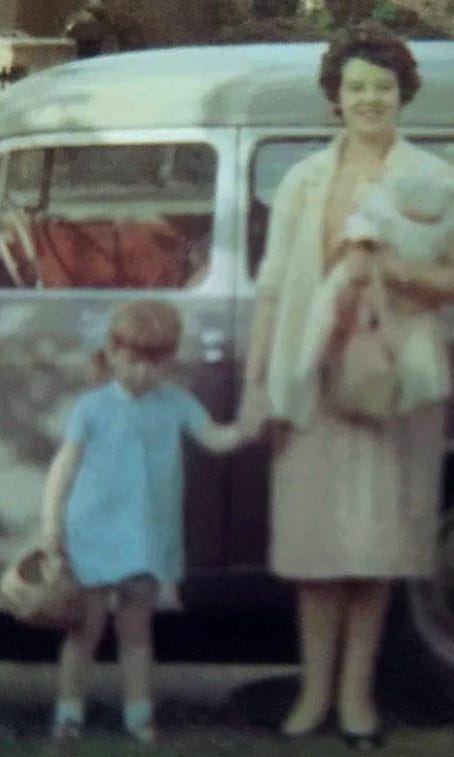
My mother and I photographed around 1966. The image is blurred by time but the memories remain crystal clear.
Today is Mother’s Day, and as such it is a day that has a way of pulling memories to the surface whether you invite them or not. Mother’s Day asks us to celebrate certainty: unconditional love, closeness, devotion, gratitude wrapped neatly in bouquets, greeting cards, brunches, lunches and dinners. But relationships between mothers and children are not always simple. In fact some relationships create warmth and distance in equal measure. Mine certainly did.
Anyone who has read pieces of my memoir already knows that I did not grow up in an especially affectionate household. Still, for a period in my younger years, my mother and I shared something close to companionship — or at least as close as she could allow herself to be with anyone. Looking back now, I realize that ours was less a traditional mother-child relationship and more an uneasy friendship built around humor, routine, and survival.
People used to comment that we behaved more like siblings than parent and child. We shared a deeply sarcastic sense of humor, the kind rooted in black comedy and observation rather than cruelty. It was often laughter that carried us through situations neither of us really knew how to navigate emotionally. Wit became our language because vulnerability never quite could.
I was not the daughter she probably expected to have. From the beginning I leaned toward everything considered masculine. I loved football, Batman, toy cars, action figures, and anything noisy or adventurous. I hated dresses, tolerated skirts only when school rules demanded them, and felt far more comfortable in trousers long before schools finally allowed girls to wear them. My father had desperately wanted a son, and perhaps in some strange way everyone simply accepted that I arrived halfway between expectation and disappointment. Of course later in life I became the son my father had wanted but that was treated as something to ignore rather than support
But back to my mother, despite our differences, my mother gave me some of the things that would shape me forever.
She introduced me to music. The soundtrack of my childhood was Elvis Presley spinning on the turntable of our rather large stereogram. Every Thursday evening we watched Top of the Pops together as though the entire world paused for those thirty minutes. Music became one of the few emotional bridges between us — something neither of us had to explain.
Some of my happiest memories are surprisingly small ones. Trips to the local café where she drank cappuccino while I ate ice cream. Coins dropped into jukeboxes. Shopping trips followed by burgers at ‘Wimpy’. Moments so ordinary they would seem forgettable to anyone else, yet somehow they remain some of the clearest images I have of her. Maybe because happiness in our house was often brief and infrequent.
Life at home was always easier when my father was absent. He was the disciplinarian, stern and humorless to my young eyes, while my mother played the softer role. She still kept me in line, still insisted I behave properly and “speak the Queen’s English,” but there was flexibility with her. There was laughter. Any humor I possess today undoubtedly came from my mother.
But illness slowly altered everything between us.
As her Multiple Sclerosis worsened, the woman who had once walked beside me gradually disappeared behind physical limitation and emotional withdrawal. By the time I was nine, our walks had stopped. Furniture became support, then a cane, then a walker, and finally a wheelchair. I watched her world shrink year by year, and with it, ours.
The hardest part was not simply witnessing her illness, but watching someone who had once felt familiar become unreachable. My mother had never been openly affectionate, but there had at least been presence. Over time even that faded into exhaustion, resentment, and silence.
When my father’s affair was eventually exposed — along with the existence of another child — whatever remained of our family fractured completely. Anger and resentment filled the house. Somehow I became tangled in blame I did not understand. I was told I resembled my father too much, that perhaps I belonged with him instead. Meanwhile, I was coming home to situations no child is equipped to manage: finding her lying on the floor after falls, feeling helpless in the face of her suffering, responding with frustration because fear had nowhere else to go.
Eventually, when she was hospitalized, her mother regained influence over her life and I became more alienated than ever. By then our relationship existed mostly in fragments and misunderstandings.
The last time I saw her, I already sensed it would be the last. I had traveled to visit after hearing she had narrowly survived a choking incident (Multiple Sclerosis can often affect the swallowing reflex). I wanted desperately to bridge the distance between us, but some gaps cannot be crossed simply because we wish them to be. When I left, she said goodbye to the nurse instead of me and the nurse had to point out that it was me that was leaving and not her.
I have replayed that moment countless times over the years. Was it confusion? Avoidance? Pain? Or was it simply easier not to look directly at goodbye?
Today, all I physically have of her is the ring she always wore — her mother’s signet ring, engraved with the fading initials H.R. But the truth is, I carry much more than that. I carry her humor. Her music. Her resilience. Her contradictions.
Mother’s Day does not make me sentimental so much as reflective. I am no longer searching for neat conclusions about who my mother was or why our relationship unfolded the way it did. Some bonds are too layered for easy understanding. We can come close to understanding them, circle around them for years, even write entire books trying to decode them, and still never fully arrive at the truth.
But despite everything — the distance, the confusion, the silences, and all the things neither of us ever learned how to say — she remains stitched into who I am. I hear her in my humor, in the music I still gravitate toward, and in the resilience I had no choice but to inherit.
Mother’s Day no longer feels simple to me, nor does grief. Some relationships are never fully resolved; they live on as questions we carry rather than stories we neatly finish. I may never completely understand my mother, or the space that existed between us, but perhaps understanding was never the point.
What remains of our relationship is something quieter and far more enduring: the knowledge that even imperfect love can leave a permanent mark on a life. And across all the years, all the distance, and all the things that went unsaid, I still find myself hoping that somewhere, somehow, she knows I never stopped trying to reach her.
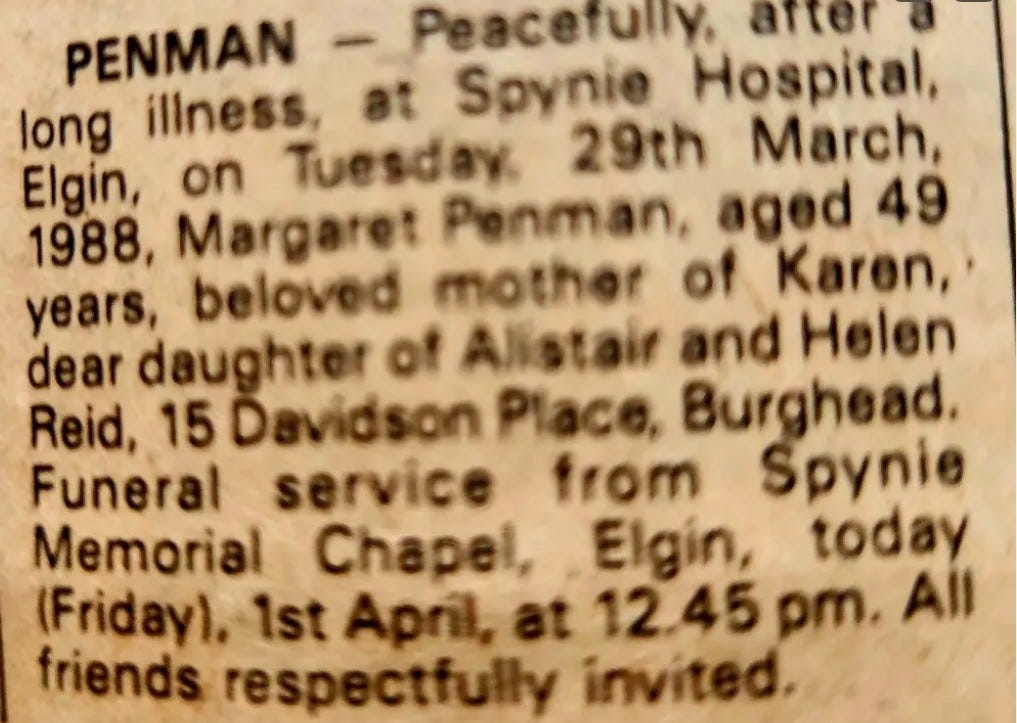
Mothers.
They can be so mysterious. Sometimes I think we only remember their lives beginning when we did but there was a lot they experienced before they met us. Your Mother was so young when she died, she didn’t get much of a chance to live did she. I’m glad you can find some lovely memories, like you my Mum died young and my memories aren’t all positive but I know I was loved and that is really all that matters!
Wow Lee! You expressed what so many want to say but an experience unique to you. Sad, deep, human. After all you said, I have to say, I honor your resilience! Happy Mother's Day to all-Thinking of mine today.